
Highlights
- Spaced temporal ensembling improves generalization in artificial neural networks
- Generalization peaks at intermediate spaced intervals and variation strength
- Periodic spacing outperforms shuffled schedules and raises the performance ceiling
- Spaced training and sensory variation jointly improve generalization in Drosophila
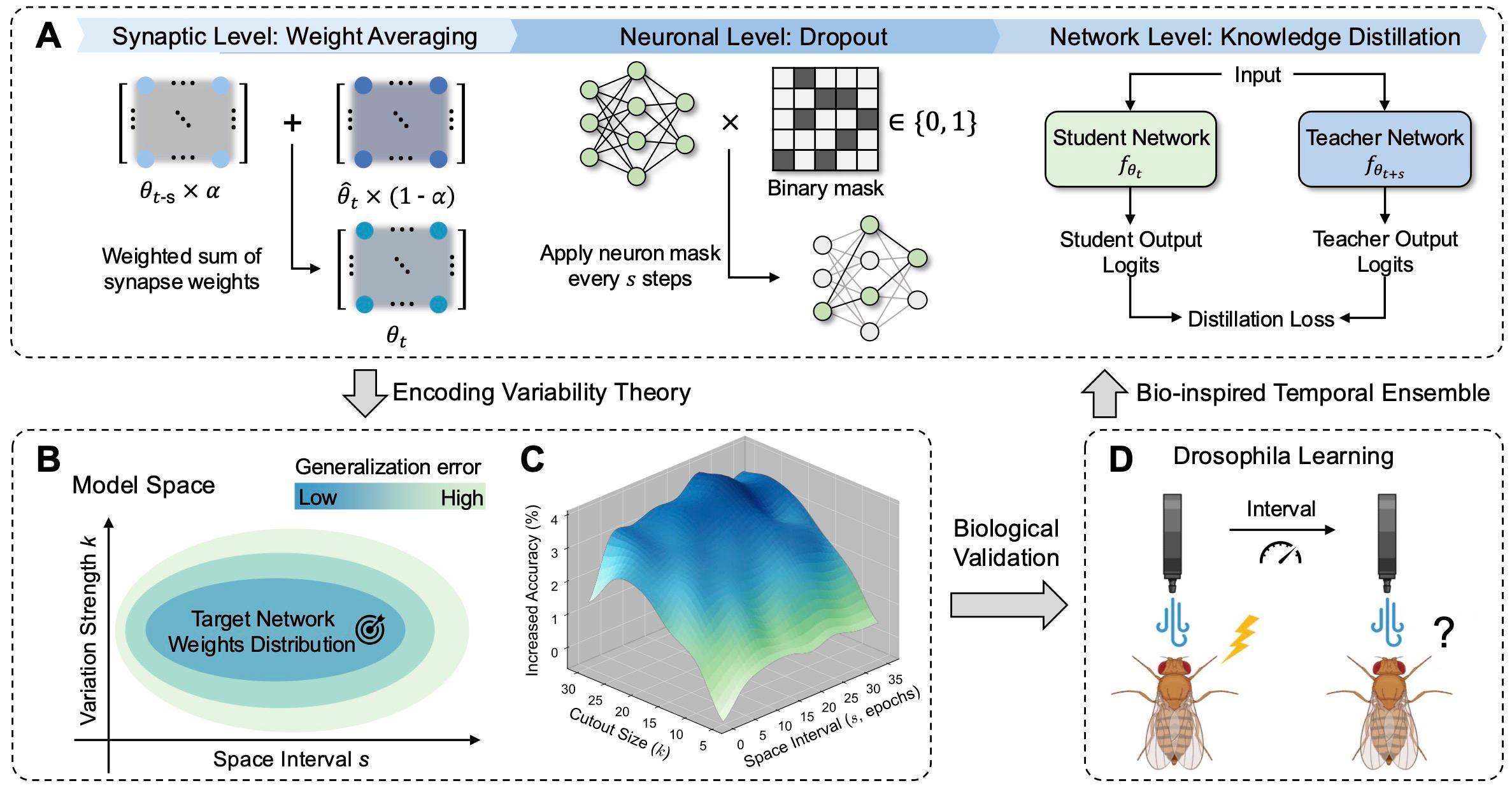
Generalization is a fundamental criterion for evaluating learning effectiveness, a domain where biological intelligence excels yet artificial intelligence faces challenges. In biological learning and memory, the well-documented spacing effect shows that appropriately spaced intervals between learning trials significantly improve behavioral performance. While multiple theories have been proposed to explain its underlying mechanisms, one compelling hypothesis is that spaced training promotes integration of input and innate variations, thereby enhancing generalization to novel but related scenarios. Here, we examine this hypothesis by introducing a bio-inspired spacing effect into artificial neural networks, integrating input and innate variations across spaced intervals at neuronal, synaptic, and network levels. These spaced ensemble strategies yield significant performance gains across benchmark datasets and network architectures. Biological experiments on Drosophila further validate the complementary effect of appropriate variations and spaced intervals in improving generalization, which together reveal a convergent computational principle of biological learning and machine learning.
|
Paper Link: https://www.cell.com/patterns/fulltext/S2666-3899(26)00073-5
|