
Highlights
- Two learning-recruited ensembles in the dDG encode memory and forgetting, respectively
- Retrieval outcome is determined by the coordinated reactivation of both ensembles
- Rac1 regulates forgetting by modulating the activity of the forgetting ensemble
- The forgetting ensemble emerges as a primary target of cognitive disorders
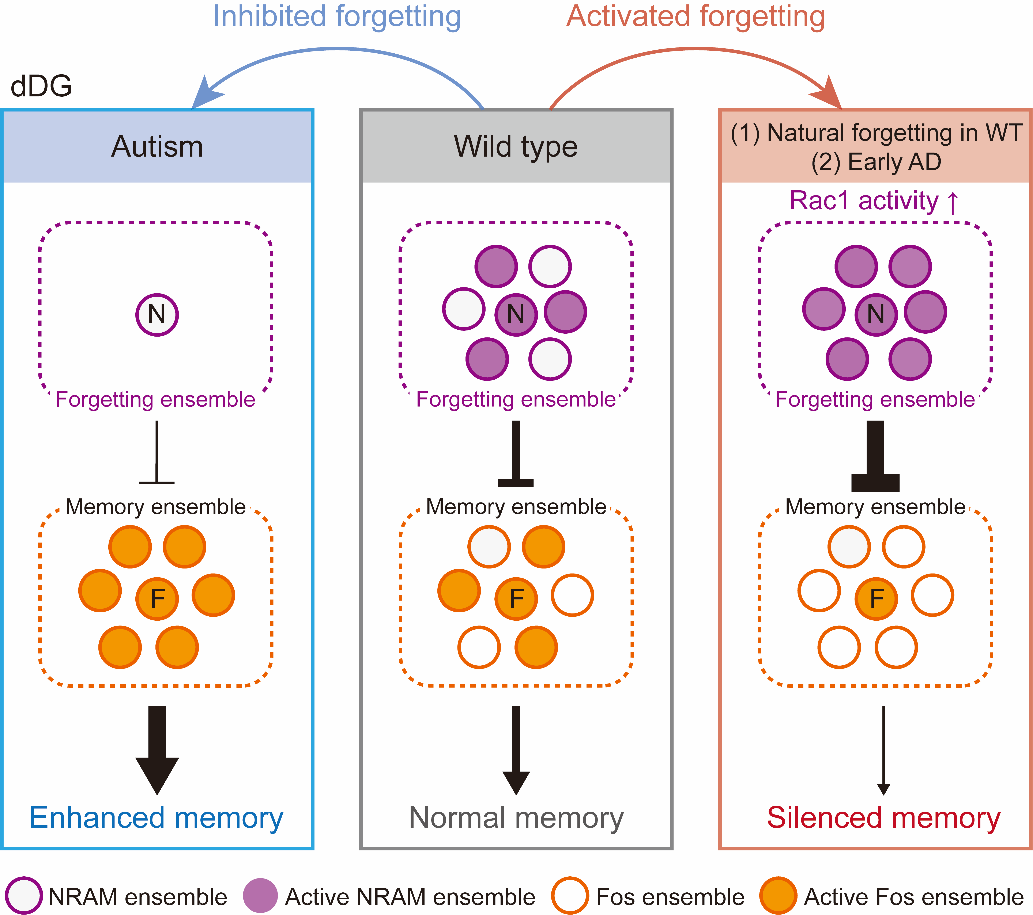
How the memory engram is organized at the cell-assembly level to support not only encoding of learned information but also memory flexibility remains elusive. Here, we propose a novel engram model encoded by two orthogonal learning-recruited neuronal ensembles in the mouse dentate gyrus. Reactivation of the Fos-tagged ensemble promotes memory retrieval, whereas reactivation of the Npas4-dependent ensemble drives forgetting, with manipulation of the forgetting ensemble inversely shifting memory ensemble reactivation. Such encoding enables flexibility in recall outcomes, ranging from full-scale memory expression to complete forgetting. Meanwhile, learned information remains unperturbed, as reactivation modifications specifically target the forgetting ensemble by regulating Rac1 activity, which is sensitive to cognitive and emotional events. Notably, memory abnormalities observed in mouse models of Alzheimer’s disease and autism are primarily linked to dysfunctions of the forgetting ensemble, suggesting that the mechanism underlying forgetting represents a major target for cognitive disorders.
|
Paper Link: https://www.sciencedirect.com/science/article/pii/S0896627325009870?via%3Dihub
|